The Ultimate B2B Sourcing Guide: Partnering with Indonesian Coconut Shell Charcoal Exporters Worldwide
The global energy and recreational fuel landscape is undergoing a monumental, permanent shift. Across North America, Europe, the Middle East, and East Asia, commercial buyers and importers are actively distancing themselves from environmentally damaging wood lump charcoal and toxic, quick-lighting chemical coals. In their place, a eco-conscious standard has taken over the market: 100% natural coconut shell briquettes.
For international wholesalers, lounge chains, and distributor networks, securing a reliable supply chain for this high-demand commodity is a primary strategic goal. As global demand surges, discerning buyers consistently direct their sourcing operations toward the Southeast Asian archipelago. Partnering with top-tier Indonesian coconut shell charcoal exporters worldwide has become the single most effective strategy for companies looking to secure premium burn quality, stable pricing, and long-term brand credibility. This comprehensive guide examines the technical benchmarks, geographic advantages, and logistical essentials required to succeed in the international charcoal trade.
The Rising Global Demand for Sustainable Biomass Fuel
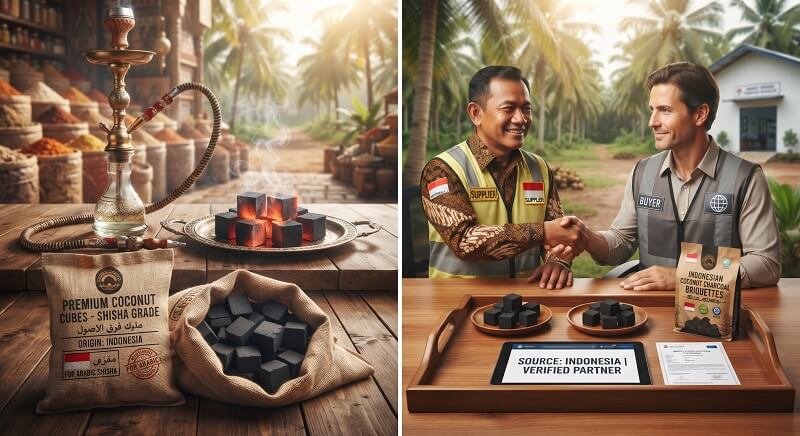
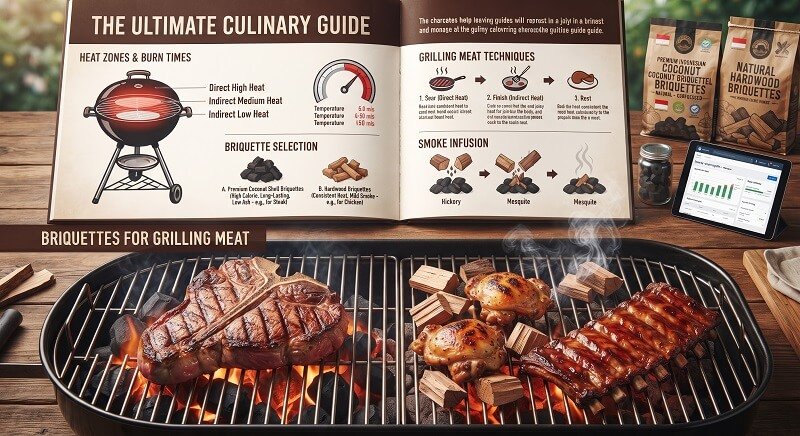
The rapid growth of the global coconut charcoal market is driven by two main sectors: the expanding international shisha and hookah industry, and the high-end culinary and commercial barbecue sector. Both markets demand a level of purity and thermal stability that traditional wood charcoal simply cannot provide.
In the recreational shisha market, the purity of the heat source dictates the entire user experience. If a charcoal briquette emits smoke, sparks, or chemical odors, it immediately compromises the curated flavor profile of the tobacco. Hookah lounge operators and retail consumers demand an odorless, tasteless, and smokeless fuel that delivers steady heat for hours. Similarly, in commercial kitchens, pitmasters and chefs require intense, consistent thermal energy that will not impart harsh artificial fumes into food.
Coconut shell briquettes fulfill these rigorous requirements through a zero-deforestation, circular economy model. Because the charcoal is produced exclusively from the discarded shells of harvested coconuts—an abundant agricultural byproduct—no trees are cut down during production. This eco-friendly footprint appeals strongly to environmentally conscious demographics worldwide and aligns seamlessly with strict international sustainability regulations.
Why Global Buyers Trust Indonesian Coconut Shell Charcoal Exporters Worldwide
Indonesia’s dominance in the global charcoal export market is not accidental. It is the direct result of an ideal combination of equatorial geography, agricultural scale, and generational manufacturing expertise.
- Unmatched Raw Material Supply: As the world’s largest producer of coconuts, Indonesia possesses a continuous, year-round harvest across major island groups such as Sumatra, Sulawesi, Java, and Maluku. This massive agricultural output guarantees an uninterrupted supply of raw coconut shells, shielding international importers from the seasonal supply shortages common in other regions.
- Superior Shell Density: Coconuts grown in Indonesia’s tropical, volcanic soil produce exceptionally thick and dense shells. When carbonized, these high-density shells yield a significantly higher fixed carbon percentage compared to shells harvested in non-volcanic or subtropical zones.
- Generational Pyrolysis Expertise: Indonesian manufacturers have spent decades perfecting the complex science of carbonization. Local producers possess deep operational knowledge regarding oxygen-restricted kilns, ensuring the raw material is converted into pure char without burning away essential carbon assets.
- Robust Export Infrastructure: Major deep-water port facilities in Jakarta (Tanjung Priok), Semarang (Tanjung Emas), and Surabaya (Tanjung Perak) provide direct maritime freight routes to key global ports in Dubai, Rotterdam, Hamburg, Los Angeles, and Melbourne.
Because of these structural strengths, leading Indonesian coconut shell charcoal exporters worldwide remain the preferred procurement partners for high-volume B2B buyers seeking factory-direct consistency.
Technical Specifications: The Anatomy of Export-Grade Quality
In the wholesale B2B trade, product quality must be strictly verified through independent laboratory testing rather than vague promotional claims. When auditing potential manufacturing partners, global buyers must evaluate four critical chemical and physical metrics.
1. High Fixed Carbon Content
Fixed carbon represents the solid combustible matter left behind after moisture and volatile gases are driven off during the carbonization process. For premium shisha-grade briquettes, reputable exporters guarantee a fixed carbon content between 80% and 85% (with specialty grades reaching up to 90%). High fixed carbon directly correlates with an extended burn duration—often exceeding 2 to 2.5 hours for shisha cubes and up to 4 hours for heavy culinary briquettes.
2. Minimal Ash Content and Pure White Color
Ash content is the non-combustible mineral residue remaining after complete combustion. High ash levels suffocate heat output and clog hookah bowls or grill grates. Export-grade shisha charcoal must maintain an ash content strictly below 2.5%, while commercial BBQ grade typically stays under 5%. Furthermore, the resulting ash must be pure white or light silver-grey. Brown, yellow, or dark ash indicates the presence of dirt, sand, or cheap wood additives.
3. Low Moisture and Volatile Matter
Excessive moisture makes charcoal difficult to light and causes dangerous popping or cracking when exposed to high temperatures. Strict export standards require moisture levels to be locked below 5%. Simultaneously, volatile matter must be kept under 15% to guarantee a completely smokeless and odorless ignition from start to finish.
4. Structural Density and Drop-Test Resilience
Briquettes must withstand transoceanic shipping and rough handling without crumbling into dust. Top-tier factories test density by performing standardized drop tests—dropping briquettes from a height of 1 meter onto a solid concrete surface multiple times to verify structural integrity before packing.
Inside the Manufacturing Process: Engineering Precision
Producing world-class charcoal briquettes requires a scientific approach to processing biomass. Established exporters follow a rigorous multi-stage manufacturing workflow:
- Raw Material Sourcing and Sorting: Fully mature, completely sun-dried coconut shells are collected from agricultural partners. Young or wet shells are rejected to maintain carbon density.
- Controlled Carbonization: The shells undergo pyrolysis in oxygen-controlled kilns, driving off moisture and volatile compounds while preserving the pure carbon core.
- Micro-Fine Pulverization: The carbonized char is crushed into an ultra-fine powder using industrial hammer mills. A finer mesh size yields a smoother, denser final briquette.
- Organic Binding: The fine carbon powder is blended with a 100% natural, food-grade tapioca (cassava) starch binder and purified water. No chemical accelerants, sodium nitrate, or synthetic additives are ever introduced.
- High-Pressure Extrusion: Hydraulic presses mold the damp mixture into specific market-requested shapes, including precision cubes (22mm, 25mm, 26mm), finger logs, or hexagonal briquettes.
- Industrial Oven Drying: The freshly molded briquettes are baked in temperature-controlled industrial ovens for 48 to 72 hours, systematically reducing internal moisture below the 5% threshold.
Navigating Maritime Regulations and Global Logistics
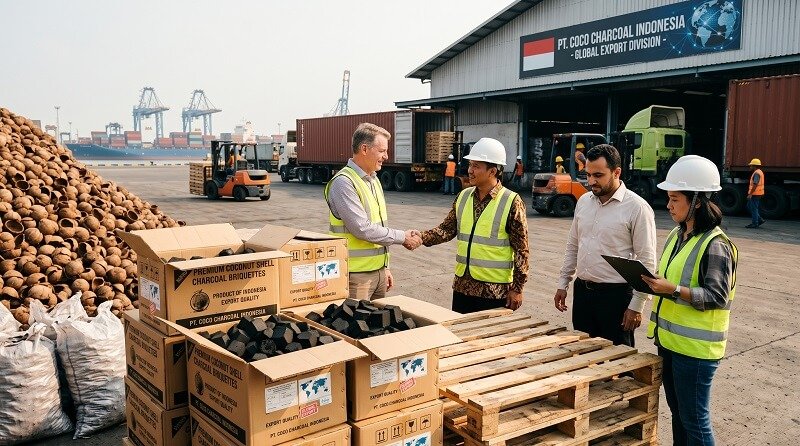
Shipping compressed charcoal across international borders requires strict compliance with maritime transport laws. Charcoal is classified under the International Maritime Dangerous Goods (IMDG) Code as a Class 4.2 hazardous material (Spontaneously Combustible Solid).
To ensure smooth customs clearance and avoid container rejections at major international ports, authoritative Indonesian coconut shell charcoal exporters worldwide provide a complete compliance documentation package for every shipment:
- Material Safety Data Sheet (MSDS): Comprehensive technical safety data outlining chemical stability and handling protocols.
- Self-Heating Test (SHT) Certificate: Issued by accredited independent testing bodies (such as SGS or Sucofindo), certifying that the briquettes have undergone oven heating tests and are safe for container shipping.
- Certificate of Origin (COO): Official documentation verifying the Indonesian origin of the cargo, allowing importers to access applicable trade tariff preferences.
- Vanning Survey Report: Independent inspection proving that the container was properly floor-loaded or palletized according to international maritime stowage standards.
Logistical efficiency also depends on container space optimization. Exporters strategically plan freight loads, fitting roughly 17 to 18 metric tons into a standard 20-foot container, or up to 25 to 26 metric tons into a 40-foot High Cube (HC) container, minimizing landed freight costs per kilogram for the buyer.
Partnering with Bounty Gold Indo Factory for Global Supply
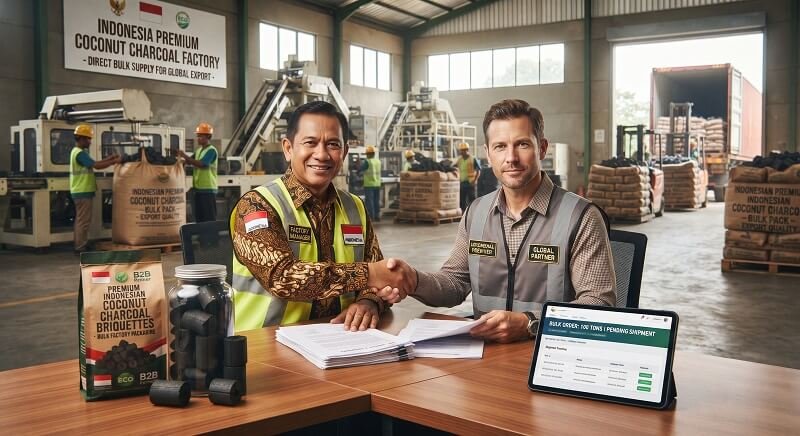
When building a long-term supply chain, importers require more than just a vendor; they need a dedicated manufacturing partner capable of scaling alongside their market growth. In the Indonesian manufacturing landscape, Bounty Gold Indo Factory has earned its reputation as an industry leader in export-grade coconut charcoal production.
Operating with complete vertical transparency, Bounty Gold Indo Factory oversees every phase of production, from direct raw material sourcing to final container sealing. Their facility is engineered to deliver unwavering consistency, ensuring that every container shipped meets exact client specifications for fixed carbon, ash percentage, and dimensions.
For B2B buyers looking to launch or expand their proprietary brands, Bounty Gold Indo Factory offers full OEM (Original Equipment Manufacturer) services:
- Custom Retail Packaging: Production of custom-branded inner boxes (1kg, 2kg, 3kg) featuring high-definition printing and internal plastic liners to shield the product from ambient sea moisture.
- Master Carton Packaging: Heavy-duty corrugated outer cartons reinforced for international freight durability.
- Tailored Formulations: Adjustments to briquette dimensions, shapes, and heat specifications based on regional consumer preferences.
Importers and commercial distributors seeking factory-direct quotes, product specification sheets, or sample shipments can connect directly with their export team via their official portal at bountygoldindofactory.com.
Securing Your Supply Chain for Strategic Growth
The transition toward sustainable, high-performance biomass energy is accelerating across global markets. As consumer quality standards rise and environmental oversight increases, businesses that secure reliable, high-grade fuel sources will capture the largest market share.
By bypassing intermediaries and sourcing directly from trusted Indonesian coconut shell charcoal exporters worldwide, international importers eliminate middleman markups, guarantee strict product consistency, and build a resilient supply chain. Aligning your procurement strategy with a proven manufacturer like Bounty Gold Indo Factory provides the technical quality, logistical compliance, and production capacity required to dominate your local market.
#indonesiancoconutcharcoalexportersworldwide #coconutcharcoal #bountygoldindofactory #indonesiancharcoal #shishacharcoal #bbqcharcoal #charcoalexporter #wholesalecharcoal #sustainablefuel